
Soil Conditions
Soil moisture is one of the biggest “invisible” factors that can make a utility locate easy one day and almost impossible the next—and most companies never talk about it. When the soil has good moisture, it conducts electricity much better. That means the locating signal can travel cleanly along the buried utility and return through the ground, giving the locator strong, stable readings and accurate marks. On a day like that, the equipment feels “dialed in” and everything seems straightforward.
But after a stretch of hot, dry weather, the exact same site can behave completely differently. Dry soil is a poor conductor, so the signal struggles to move through the ground and stay on the intended line. The locator may see weak or jumpy signals, sudden changes in apparent depth, or marks that seem to drift toward other nearby utilities or metal objects. Nothing about the pipe or cable changed—only the soil—but the entire electrical circuit the locator relies on is now working against them instead of with them.
This is where experience and deeper technical knowledge really matter. A well‑trained locator understands how to adapt to changing ground conditions: improving the quality of their connections, adjusting frequencies and power levels, repositioning ground stakes, and double‑checking results with multiple techniques instead of just “chasing the loudest beeps.” Companies that only train their staff to push buttons and follow the screen often miss these subtleties, which can lead to inaccurate marks and unnecessary risk. My approach is to treat each job as a real diagnostic problem, not just a checkbox task—because understanding how soil, moisture, and electricity interact underground is the difference between a rough guess and a professional locate you can trust.
High Frequency
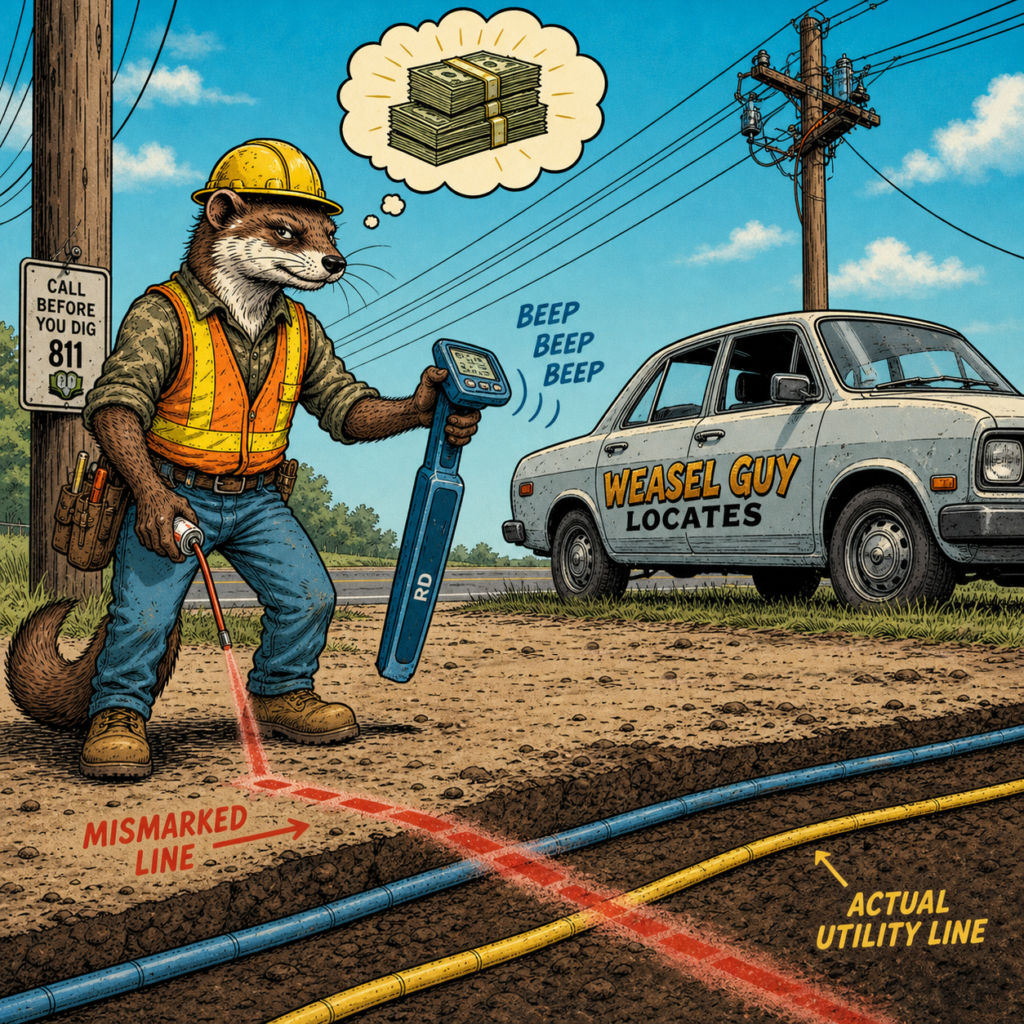
Most people are surprised to learn that the Common Ground Alliance reports roughly two‑thirds of utility damages are traced back to locator error. That’s a staggering number, and one big reason is a very fixable technical mistake: bleeding off onto the wrong line. When a locator uses too much power or too high of a frequency, the signal doesn’t just stay on the intended utility – it “jumps” onto nearby pipes, cables, tracer wires, or even fences. The locator then follows a loud, beautiful signal that looks convincing on the screen but is actually coming from the wrong facility.
This happens with brand‑new techs and “experienced” locators alike, usually because of rushed training, bad habits, or the pressure to get in and out of a site as fast as possible. Turning everything up to max can feel like a shortcut, but it trades accuracy for speed and shifts risk onto the property owner and the excavator. A mismarked line isn’t just a technical error; it’s what leads to damaged utilities, costly delays, safety hazards, and finger‑pointing after the fact.
At Bigfoot Locating, we deliberately work the opposite way. We don’t default to high power and high frequency just to make the receiver scream and move on to the next ticket. Instead, we take the extra time to choose the right frequency, use only as much power as the job truly needs, and verify that the signal is actually staying on the intended line. That slower, more methodical approach may not maximize the number of jobs in a day, but it does maximize something more important: the quality and reliability of every mark we put on the ground.
Murphys Law
Many years ago while working for the biggest production 811 Locate outfit in the world I was a younger locator. Much younger and slightly more handsome and skinnier….. Those were the days, all my joints worked and I could touch my toes.
Murphy’s Law says, “Anything that can go wrong, will go wrong.” Edward A. Murphy Jr., an aerospace engineer at Edwards Air Force Base, coined that phrase back in 1949, and anyone who’s worked around underground utilities knows he was right.
Two projects before breakfast
On this particular morning, I was at my second “project” of the day by 6:50 a.m. The first one was a daily meet with one of my favorite contractors at 37th Ave NE and Stinson. Every morning around 6:00 a.m. I’d mark a nightmare of a locate there, from 37th all the way past 40th on Stinson, or get him to sign a meet sheet saying exactly where he was going to dig so my documentation was solid.
Once that circus was handled, I’d hustle over to NE 36th Ave in St. Anthony, MN, just off the New Brighton border. My job was to mark every single utility from Skycroft Drive down to Highcrest Road NE, every day that spring and summer, before I even touched my “routine” 811 tickets.
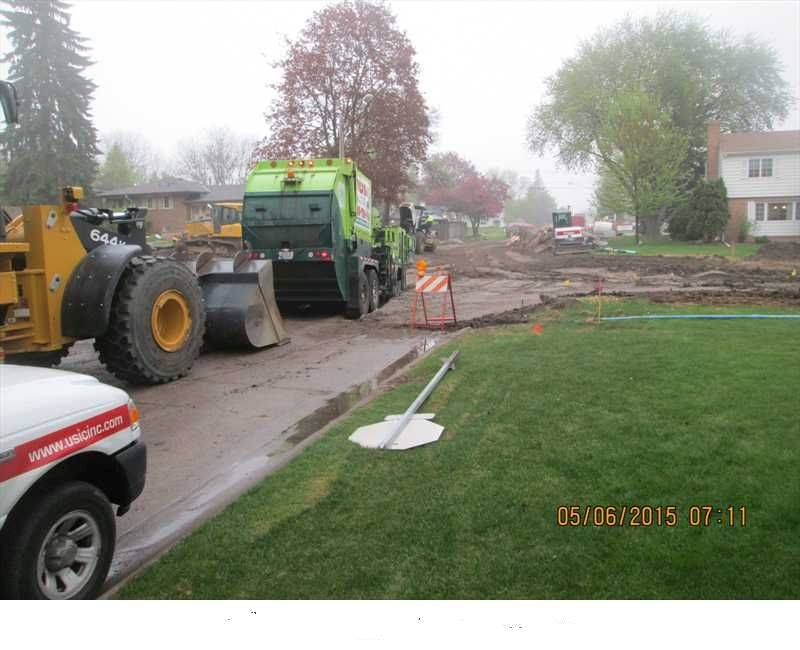
This particular morning, it had rained about six inches the night before. My socks were soaked, my Caterpillar boots were crusted in mud, and every step felt like walking in giant mud covered clown shoes. I parked at Chelmsford and 36th Ave and started finishing my paperwork and uploading photos from that first meet.
That’s when the garbage truck rolled in.
I thought quicksand was just in the movies
The day before, the contractor had the whole intersection dug up to a depth of about 20 feet to install new sewer and water for a city road project. Everything had just been freshly backfilled. After that much rain, the soil wasn’t just soft; it was actually Quicksand.
The garbage truck didn’t make it ten feet off the old pavement before the ground started swallowing the front end. At first it looked manageable. Maybe if he just eased through slowly, he’d be fine. Nope.
Then the tires started spinning. Oh , geez. Would you look at that.
For the next 10–20 minutes, I sat there watching this poor guy rock the truck back and forth, trying every trick he knew. Every move sunk the truck deeper. While he fought the mud, I almost forgot about my soaked boots and the fact that I was staring down another 15 hours of work just to stay caught up.
Eventually, he gave up. And right about then, the project foreman arrived.
Mud Mud Everywhere
Around 7:00 a.m. every morning, the young foreman from Latour Construction Justin showed up to tell me, as he always did, that he needed all 47 houses on 36th Ave marked. He had deadlines, inspectors, and a boss who cared about results, not excuses.
So did the garbage man.
Seeing the truck buried in what used to be a road wasn’t how the foreman wanted to start his day. But instead of complaining, he went to work solving the problem. He had his best equipment operator grab the biggest front-end loader you’ve ever seen and bring it into the mud.
The operator carefully maneuvered that beast behind the garbage truck and hooked up heavy chains—the kind you’d expect to see holding a battleship to a dock. With a slow, steady pull, he started dragging the garbage truck out of the hole it had dug itself into.
Adapting to adversity
While this was going on, the rest of the crew showed up. Justin, the foreman of Latour , stepped in and organized them. He sent the whole crew down 36th Ave, house by house, all 47 of them.
Each worker grabbed a trash can, pushed it through the mud down to the waiting garbage truck on the stable pavement, and brought it back empty. They did the same for recycling. It wasn’t in anyone’s job description, but it was the only way to make the situation work.
From that day through the rest of the project, garbage day went like this:
- The garbage truck would stop safely on the concrete, just outside the torn-up section of road.
- The construction crew would run a trash-can shuttle service through the mud.
- The route got done, nobody’s truck sank, and the project kept moving.
None of this was in the original job plans. It was just a bunch of people adapting on the fly so everyone could do their jobs.
the disappearing jeep
The mud that swallowed the garbage truck had already claimed another victim. Some teenagers had taken their new off-road Jeep out for a test in the construction zone sometime the night before or early that morning.
We found the tire ruts and eventually the Jeep itself, buried up to the frame about half a block from the intersection. But by the time we had the garbage truck situation under control, the Jeep had mysteriously vanished. Apparently, they managed to get it yanked out of there too—hopefully with a good story and a lesson learned.
The lesson learned
At any given time the Universe will throw you a curve ball when you least expect it. How you handle it will define whether you are successful or whether you fail.
- Soil doesn’t behave the way the plans say it should.
- Weather turns your jobsite into soup overnight.
- Equipment gets stuck, or timelines shift, or access disappears.
You can’t control all of that. What you can control is how you respond.
On this job, nobody quit, nobody went home, and nobody tried to pretend the truck wasn’t buried. The foreman, the operator, the crew, the garbage man—we all adjusted and found a way to keep the project moving and the neighborhood serviced.
That’s how I approach underground utility locating every day:
- Expect Murphy’s Law to show up.
- Build documentation and communication that hold up when problems show up.
- Stay calm, get creative, and adapt instead of throwing in the towel.
If you want a locator who has already lived through mornings like this and still got the job done, that’s exactly the kind of work we do at Bigfoot Locating.

Do I need a Private Locate?
Calling 811 is a good start and the law. After you call 811 be sure to call Bigfoot Locating to locate any private utilities you may have present in your dig area. A large percentage of the calls we get from customers actually come after the utility has already been damaged. Repairing a gas line or a power line to an outbuilding or garage can cost thousands of dollars. And that is just the money side. Buried Utilities are dangerous people can easily be hurt or worse from digging without a locate.
Your contractor is legally required to have an 811 dig ticket that is current and valid in order to dig , but 811 doesn’t cover almost 60% of the other things that are buried in the ground. Most recently Bigfoot Locating was called out to a very nice house in the Metro Suburbs to locate a gas line that had already been hit by a contractor doing some work on a backyard pool. Upon arrival we discovered 5 other buried lines right in the excavation area including 3 live power lines only inches away from the already severed gas line. The homeowner had no idea any of the lines were there and was very thankful we were able to locate them for them to keep the contractor from finding them by accident later. The homeowner and contractor had both called 811 before the dig and the locators had come out and marked the public utilities. Unfortunately there were several private lines serving the pool and the detached shop that were not covered by the 811 locate. Nobody was hurt thankfully but the homeowner is without gas for their furnace and stove until they can find someone to come out and repair the line. Unscheduled repairs cost even more than routine ones, so avoid the hit to your bank account and the headache and be sure to call Bigfoot Locating to come out and mark your buried private utilities ahead of time before you or your contractor digs.

Who you pick to do your private locates matters.
In the world of Utility Locating there are two basic sides. Production Locators and Private Locators. There are many choices available when you do a web search for Private Utility Locates. They are not all equal. The truth is the big corporate companies have a big problem when it comes to private locates. They just aren’t usually very good at them. The reason for this is relatively simple, the big companies are owned by share holders. They aren’t really concerned with their employees all they care about is profits and losses. When someone goes to work for one of these big companies they usually don’t even make it through a full dig season.
Sometimes the only requirement to get a job as a production locator is having a pulse. When working for one of the largest locate companies in the world every spring we would get 15-20 new hires to help us in our work areas. By the end of summer maybe 1 or sometimes 2 were left. It is a tough job and very demanding and the learning curve is very steep. Big locate companies actively plan to have damages and accidents , to them it is just a cost of doing business. They save money by cutting corners on training and employee pay and just try to make more money than they lose every year to costly damages.
Bigfoot Locating has over 15 years of real hands on experience doing real locates out in the field. That equates to over 45,000 hours of actual utility locating and that is being very conservative. If you call up one of the big 811 companies who claim to also do private locates not only will you get over charged but odds are the person who shows up to do your locates will be new nervous and inexperienced. It isn’t the employees fault, the big companies just don’t invest time in training anymore they are more concerned with having bodies in the field to handle the overwhelming amount of work they pile on their poor employees. There aren’t many jobs with Mandatory overtime and weekend work but production 811 locating is one of them. The sad truth is most 811 locators burn out in a few months and quit and move on. I have seen companies with over 50 employees on their roster with less than 5 years experience between all of them.
It all boils down to experience or more importantly lack thereof. The other big problem with hiring a big name 811 company to do your private locates is that many of them really only specialize in one thing. If the big company only usually locates their own fiber optic cables and that is all their employees do all day every day and they don’t locate any other types of utilities then even if their locators have 5 years of experience they only have 5 years of experience locating fiber optic cables. They don’t have any practice troubleshooting gas lines or electric lines or water or sewer lines. All of which are very different to locate and troubleshoot , the experience is not interchangeable across types of utilities because they are so different.
That is why who you pick is important, the other guy might be really good at locating telephone cables or water stops but have no idea how to locate a septic system or a private well head or sprinkler control lines. Bigfoot Locating has done it all, for years , every day , over and over again, twice. So when you pick us you can rest assured you are making the right choice.